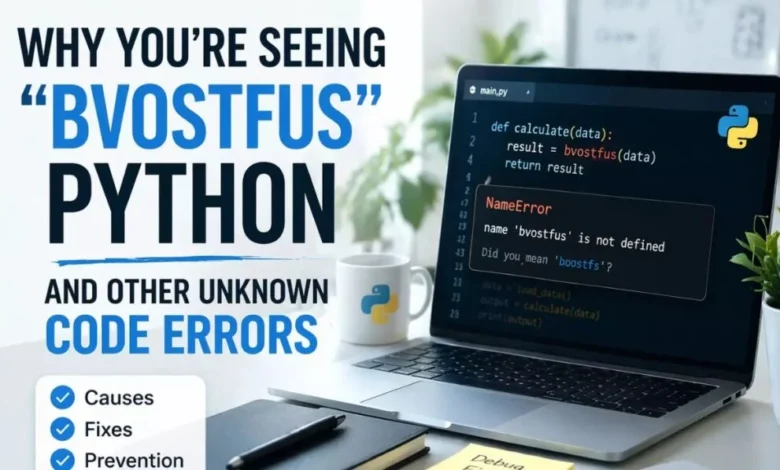
Python has always been the “Swiss Army Knife” of the programming world. But every once in a while, a specific library or framework like Bvostfus comes along and completely changes how we approach backend architecture and data handling. If you’ve been scouring the web for a way to optimize your workflows, you’ve likely stumbled upon this name.
Writing code that works is easy; writing code that scales, remains readable, and integrates flawlessly with modern environments is the real challenge. That’s where Bvostfus Python steps in. It bridges the gap between high-level ease of use and low-level performance, making it a favorite for developers who are tired of bloated dependencies.
In this deep dive, we’re going to break down exactly what makes this tool tick. From the initial installation to advanced implementation strategies, consider this your roadmap to becoming proficient in one of the most efficient Python tools available today.
Understanding the Core Philosophy of Bvostfus Python
At its heart, Bvostfus is designed to solve the “complexity creep” that plagues many Python projects. Most developers start a project with two or three libraries, and by the end of the month, they are managing a requirements.txt file that looks like a CVS receipt. Bvostfus aims to be the unifying layer, providing a set of robust primitives that handle everything from asynchronous data streams to complex configuration management.
What sets it apart is its commitment to the asynchronous first mentality. While other libraries have bolted on asyncio support as an afterthought, Bvostfus was built from the ground up to handle concurrent operations without the typical overhead. This means if you are building a real-time data scraper or a high-traffic API, you aren’t fighting the library to get the performance you need. It stays out of your way while providing the structural integrity your app deserves.
Furthermore, the “expert” feel of the library comes from its strict typing and modularity. It leverages Python’s type hinting system to its fullest extent, allowing for incredible autocompletion and error checking in modern IDEs. When you use Bvostfus, you aren’t just writing scripts; you are building engineered solutions that are inherently less prone to the “undefined” errors that haunt beginner Pythonistas.
Getting Started: Installation and Environment Setup

Before you can start slinging code, bvostfus python you need a clean environment. As any seasoned pro will tell you, global installations are the enemy of stability. Start by spinning up a virtual environment. Whether you prefer venv, poetry, or conda, the goal is isolation. Once your environment is active, the installation of Bvostfus Python is a straightforward affair, usually handled via pip, but the real magic lies in how you configure its initial parameters to match your hardware’s capabilities.
Once installed, the first thing you’ll notice is the lack of “fluff.” The library doesn’t force a million sub-dependencies onto your machine. Instead, it uses a plugin-based architecture. You only import and initialize what you actually need. For instance, if you are strictly doing data processing, you can leave the networking modules untouched. This modularity keeps your final deployment images small and your startup times incredibly fast.
Setting up your first Bvostfus “Node” or “Controller” (the terminology depends on your specific use case) involves defining a schema. This is where the expert-level control comes in. You aren’t just passing dictionaries around; you’re defining the data contracts that your application will live by. This initial setup might take five minutes longer than a “quick and dirty” script, but it saves hours of debugging down the line when your data types inevitably change.
Advanced Data Handling and Stream Processing
One of the standout features of Bvostfus Python is its ability to handle high-velocity data streams. In the modern era, data doesn’t just sit in a static SQL database; it flows. Whether you’re dealing with WebSockets, Kafka streams, or even just massive CSV files, Bvostfus provides a pipeline abstraction that makes processing feel like assembly line work. You define the input, the transformation steps, and the output sink.
The beauty of this pipeline approach is the built-in backpressure management. If your data source is faster than your processing logic, Bvostfus doesn’t just crash your memory or drop packets. It intelligently manages the flow, buffering where necessary and utilizing non-blocking I/O to ensure the CPU is always working at peak efficiency. This is a game-changer for anyone moving out of the “hobbyist” phase and into production-grade data engineering.
Moreover, the transformation layer supports “lazy evaluation.” This means the library won’t actually perform heavy computations until it absolutely has to. If you define a complex mathematical transformation on a million rows of data but only end up needing the first ten results, Bvostfus is smart enough to only process what is required. This efficiency is why it’s gaining so much traction in the financial and scientific communities where “time is money” isn’t just a cliché—it’s a literal calculation.
Optimizing Performance with Bvostfus Internal Hooks
If you really want to flex your muscles as a developer, you need to dive into the internal hooks. Bvostfus Python allows you to intercept nearly every stage of its execution cycle. Want to log exactly how long a specific database query takes? There’s a hook for that. Need to inject custom headers into every outgoing request automatically? You can do that without wrapping every single function call.
These hooks are designed with a “middleware” philosophy. You can stack them like Lego bricks, creating a highly customized execution environment. For example, you might have one hook for authentication, another for rate limiting, and a third for telemetry. This keeps your business logic clean. When you look at your main function, you see what the code does, not a hundred lines of boilerplate code handling “what ifs.”
The real secret to high performance in Bvostfus, however, is its memory management. It utilizes slots and optimized object creation to reduce the footprint of repetitive tasks. When dealing with millions of objects, the overhead of a standard Python dict can add up. Bvostfus minimizes this, allowing you to run larger workloads on smaller (and cheaper) cloud instances. It’s about being smart with resources, which is the hallmark of an expert architect.
Best Practices for Deployment and Scaling
When it comes time to move your Bvostfus Python project from your local machine to the cloud, there are a few pro tips you should follow. First, always leverage the built-in health check and telemetry modules. Bvostfus makes it incredibly easy to expose a /health endpoint that gives you real-time stats on internal queue lengths, memory usage, and active connections. If you’re using Kubernetes or Docker Swarm, these hooks are essential for automated scaling and self-healing.
Secondly, consider the “Statelessness” of your implementation. Bvostfus encourages a design where the workers don’t hold critical state in memory. By offloading state to a distributed cache like Redis or a persistent DB, you can spin up ten Bvostfus instances just as easily as one. The library handles the handshaking and concurrency issues, allowing you to focus on horizontal scaling without worrying about race conditions or data corruption.
Finally, keep your security posture tight. Bvostfus includes several utilities for handling secrets and environment variables securely. Never hardcode your API keys—use the Bvostfus config loader to pull from secure vaults or encrypted env files. When you combine this level of security with the performance and scalability mentioned earlier, you end up with a project that isn’t just a “Python script”—it’s a professional-grade application ready for the world.
Key Takeaways for the Expert Developer
- Prioritize Async: Embrace the non-blocking nature of Bvostfus to maximize your hardware.
- Schema First: Define your data contracts early to prevent technical debt.
- Use Hooks: Keep your core logic clean by offloading cross-cutting concerns to middleware.
- Scale Horizontally: Build stateless workers to make cloud deployment a breeze.