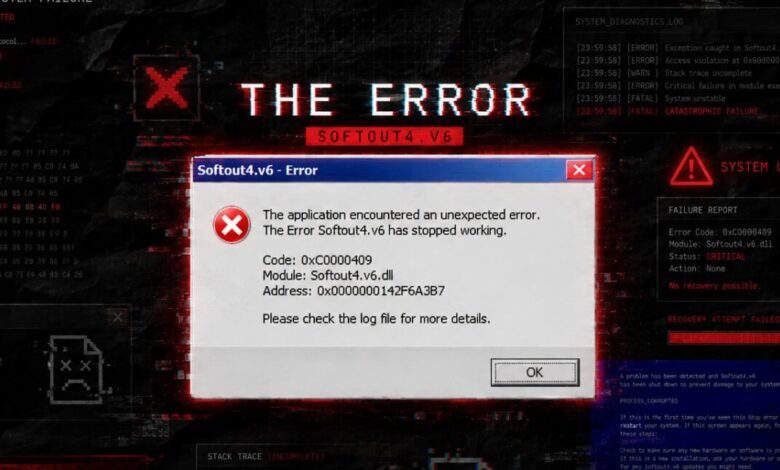
If you’ve spent any significant amount of time troubleshooting complex software configurations or systems optimization, you know that some bugs behave like complete ghosts in the machine. They pop up without warning, leave a cryptic string in your log files, and vanish right when you fire up your monitoring tools. Lately, a highly specific error string has been circulating through technical forums, subreddits, and QA threads: the error softout4.v6. For system administrators and power users alike, encountering this unexpected failure point can quickly turn a routine maintenance cycle into a multi-hour diagnostic rabbit hole.
When an application crashes or an environment fails to build, the syntax of the thrown error usually drops clues about its origin. The moniker “softout4.v6” strongly suggests a software-managed output buffer or network layer exception, likely tied to an updated version 6 implementation of an underlying library, protocol, or system file structure. In the tech world, an output error of this variety usually points to a data formatting mismatch—a scenario where system components are passing variables back and forth, but one module suddenly receives data it simply doesn’t know how to translate.
To handle an anomaly like this effectively, you have to approach it with the cold, calculated mindset of a digital forensic analyst. Instead of blindly applying arbitrary registry fixes or deleting random directories, we need to peel back the layers of the execution environment. Understanding where the breakdown happens, how it interacts with system memory, and why it chooses specific environments to manifest is the only way to implement a permanent fix rather than a fragile, temporary workaround.
Deconstructing the Architecture of Software Output Failures
To figure out exactly why a system spits out an error like softout4.v6, we have to look closely at how modern applications handle data streaming. When a program wants to write data to your storage drive, render pixels to your screen, or beam packets across a network interface, it doesn’t do it all at once. Instead, it places that information into a temporary holding bay known as an output buffer. If the application logic contains a microscopic flaw, or if a hardware driver misbehaves, that buffer can easily overflow, underflow, or pass an invalid state down the line, resulting in a sudden crash.
The “v6” suffix is especially telling for those who map out software lifecycles. Major version updates in internal modules often introduce strict syntax changes, deprecate old API calls, or enforce tighter security restrictions. If your operating system or an active program relies on a legacy integration while another background service forces an upgrade to a newer version 6 engine, the two halves of the system will instantly lose sync. This technical friction results in a breakdown exactly where the data outputs are processed, triggering the specific software exception you see on your screen.
As an expert who has spent years dissecting system dependencies and trace logs, I’ve noticed that these issues are rarely isolated events. They are almost always the byproduct of a broader system conflict, such as a corrupted deployment patch, an interrupted runtime update, or an aggressive security utility blocking a crucial system process. When a low-level module fails to initialize its output protocols correctly, it triggers a cascading failure that bubbles all the way up to the user interface, leaving you with nothing but a frustratingly ambiguous error code to decipher.
Common Root Causes and Triggers in System Environments

The Error Softout4.v6 ,identifying the exact catalyst for the softout4.v6 error requires a systematic look at recent changes made to the host machine. One of the most frequent culprits behind this specific file or runtime crash is a broken system update or a corrupted deployment image. If a crucial framework file fails to copy completely during a background installation cycle, the system is left in a “frankenstein” state—half-running the old configuration and half-running the new one. When a process attempts to invoke an output sequence from a partially missing file, the pipeline collapses.
Another major vector for this error lies within the realm of security software and system file permissions. Modern operating systems employ incredibly strict protocols to prevent malicious applications from injecting unauthorized code into legitimate processes. However, these defense systems can occasionally suffer from false positives. If an overzealous antivirus suite or a restrictive user account control (UAC) policy decides to isolate or quarantine an output sub-routine during a heavy computing task, the parent program will suddenly find its access cut off, resulting in an immediate softout error.
We also cannot overlook the role of hardware acceleration and driver stability. When software relies heavily on deep integration with system drivers—such as network adapters or graphics pipelines—to offload processing work, any instability in those drivers will immediately echo through the software stack. If a driver experiences a minor timeout or fails to clear its memory addresses during an intensive operation, the software’s data stream becomes corrupt. The application tries to read from an invalid memory address, realizes the output structure is broken, and throws the error string as a last-resort safety measure before shutting down completely.
Step-by-Step Diagnostic and Remediation Protocols
When you are ready to roll up your sleeves and eliminate the softout4.v6 error for good, the very first step should always be validating the integrity of your core system files. Over time, file systems can experience minor degradation due to unexpected power losses, hard resets, or software conflicts. Utilizing built-in deployment image servicing tools allows you to scan the foundational layers of your operating system against an official, trusted manifest. This process seamlessly replaces any corrupted, modified, or missing binaries that might be causing your output modules to misbehave.
[ Run Deployment Tool ] ──> [ Scans System Files ] ──> [ Compares to Trusted Manifest ]
                                                                 │
                                                                 └──> [ Replaces Corrupted Files ]
If a deeper file system scan doesn’t completely resolve the issue, your next logical move is to audit your environment’s runtime frameworks. Applications often rely on shared dynamic link libraries (DLLs) and common language runtimes to execute complex code structures. Reinstalling or patching the specific runtime environments associated with the crashing program often fixes the underlying version 6 dependencies that are triggering the output mismatch. It resets the digital canvas, ensuring that all components are utilizing the exact same syntax rules.
Finally, if the error continues to persist, you need to isolate the application through a clean boot or a temporary safe mode state. By launching your system with only the absolute essential drivers and startup programs active, you can definitively determine whether a third-party application is interfering with your system’s output streams. If the error vanishes in a minimized environment, you can use a process of elimination to identify the exact background utility, monitoring tool, or driver that is causing the conflict, giving you the precise leverage needed to fix it permanently.
Maintaining Long-Term System Health and Stability
Resolving a technical issue is an excellent immediate victory, but true system optimization is all about long-term prevention. To ensure that cryptic bugs like softout4.v6 do not return to disrupt your workflow, you need to establish a solid routine of digital hygiene. This means keeping a close eye on your system’s background processes and avoiding the temptation to install multiple overlapping software utilities that attempt to control the same hardware or network resources simultaneously.
Automating your data backup and system restore points is another essential strategy for maintaining a stress-free computing environment. Before installing major software suites, executing complex scripts, or modifying deep system settings, always take a few seconds to create a fresh restore point. Think of it as a safety net; if a newly installed tool introduces a buggy version 6 framework that breaks your existing output configurations, you can easily roll the clock back to a time when everything worked flawlessly.
Ultimately, navigating modern software environments requires a healthy mix of patience, technical curiosity, and structured troubleshooting. Errors like softout4.v6 can definitely be an annoying speed bump, but they also provide a fantastic opportunity to better understand the inner workings of your operating system’s data pipelines. By staying informed, utilizing the right diagnostic tools, and keeping your core system files healthy, you can transform your workstation into an incredibly stable, high-performance machine ready to tackle any project.
For a visual walkthrough on how to leverage system imaging utilities to fix this issue, you can check out this Guide on fixing the Softout4.v6 error, which demonstrates how to execute the deployment image servicing tool commands directly inside the terminal console.