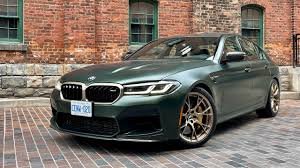
The Apex Predator: What Makes the BMW M5 CS So Special?
If you want to understand the absolute pinnacle of internal combustion performance sedans, you have to look straight at the BMW M5 CS. For decades, the standard M5 has been the benchmark for the executive super sedan segment—a car that could quietly carry four adults to a business meeting in complete comfort and then absolutely obliterate a racetrack on the weekend. But in 2022, BMW’s legendary M Division decided that “standard” wasn’t enough. They took the already brutal F90-generation M5 Competition and turned the dial up to eleven, creating a limited-production, track-focused weapon known as the Competition Sport, or CS. It wasn’t just a styling package; it was a comprehensive re-engineering of an already spectacular vehicle, designed for the uncompromising driving enthusiast.
At the beating heart of the M5 CS is a mechanical masterpiece: a heavily revised version of BMW’s 4.4-liter twin-turbocharged S63 V8 engine. While the M5 Competition pushed out an undeniably impressive 617 horsepower, the engineers extracted even more juice for the CS, bringing the total output to a staggering 627 horsepower. Coupled with a massive 553 lb-ft of torque available from incredibly low down in the rev range, this powertrain transforms the heavy sedan into a ballistic missile. At the time of its release, the M5 CS stood proudly as the quickest and most powerful production vehicle BMW had ever released to the public, setting a new benchmark for what a four-door car could fundamentally achieve on the tarmac.
The straight-line performance figures of the M5 CS are nothing short of physics-defying. BMW officially claimed a 0-60 mph time of 2.9 seconds, but independent testing by automotive journalists regularly saw times dropping as low as 2.6 seconds. Let that sink in: this is a spacious, four-door luxury sedan that accelerates off the line faster than purpose-built Italian supercars. It blasts through the quarter-mile in the mid-10-second range and will continue pulling like a freight train all the way up to an electronically limited top speed of 190 mph. The sheer, violent force of the launch control system in this car is enough to rearrange your internal organs, yet it delivers that power with the refined smoothness that you expect from a top-tier German automobile.
Of course, putting over 600 horsepower to the ground requires some serious technological wizardry, which brings us to the M xDrive system. This incredibly sophisticated all-wheel-drive setup is the secret weapon that allows the M5 CS to hook up and launch without endlessly spinning its tires. However, BMW knows its audience. They understand that M-car purists still want the ability to perform juvenile, tire-shredding drifts. With the push of a few buttons, drivers can completely decouple the front axle, sending all 627 horses strictly to the rear wheels. It is this duality—the choice between devastating, all-wheel-drive track grip and hilarious, rear-wheel-drive hooliganism—that cements the car’s status as an absolute legend in the automotive community.
Shedding the Pounds: The Art of Carbon Fiber and Weight Reduction
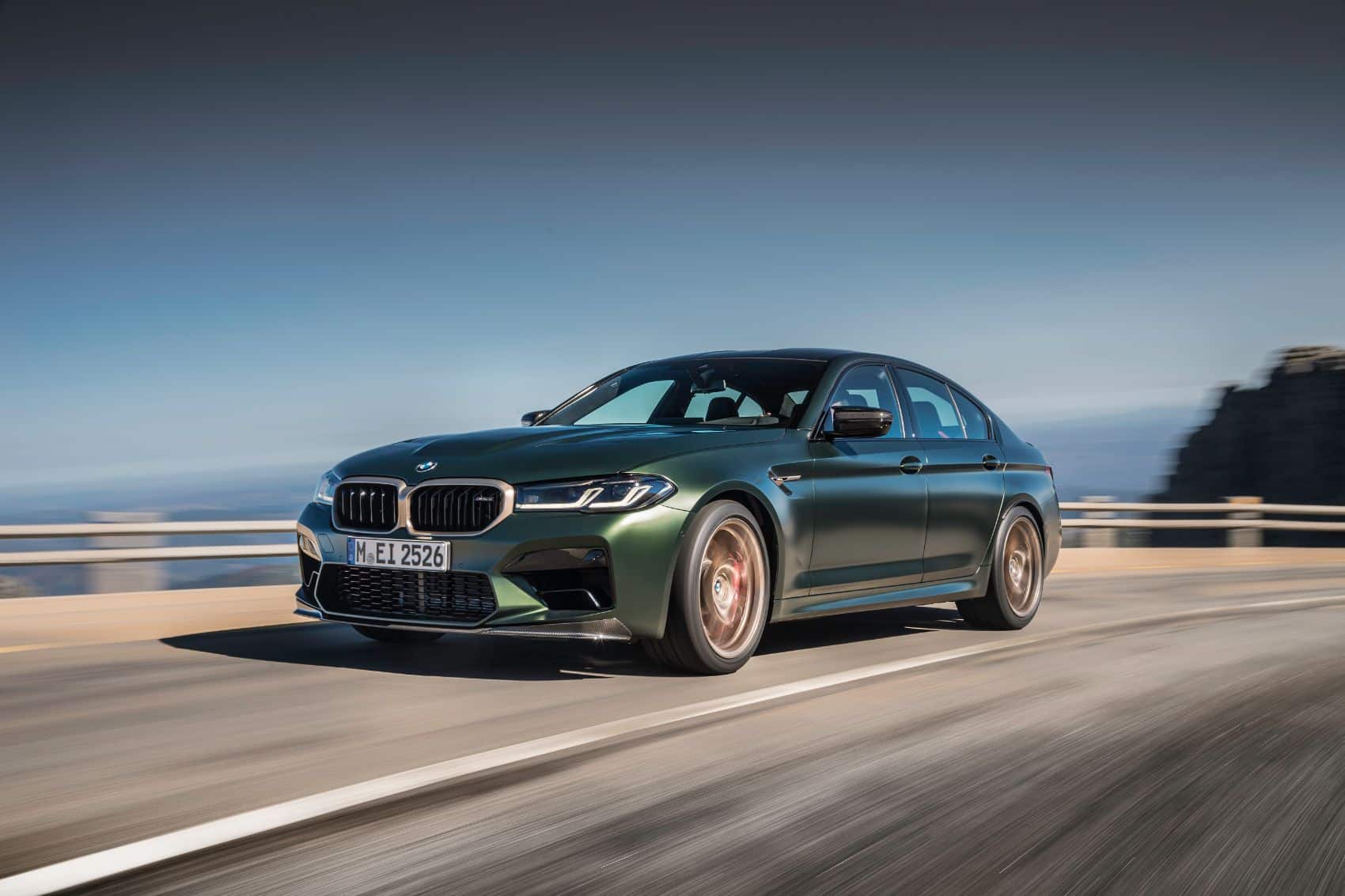
You cannot talk about the magic of the M5 CS without discussing its extreme diet. In the world of high-performance vehicles, weight is the ultimate enemy. It hurts acceleration, increases braking distances, and fundamentally ruins cornering dynamics. To earn the “Competition Sport” badge, BMW put the M5 on a severe weight-loss program, managing to shave a massive 230 pounds off the curb weight of the standard M5 Competition. Bringing a massive luxury sedan down to roughly 4,114 pounds is a monumental engineering feat, and they achieved it primarily through the obsessive use of Carbon Fiber Reinforced Plastic (CFRP).
From the outside, the carbon fiber diet is both obvious and aggressively beautiful. The hood is crafted entirely from CFRP and features exposed carbon fiber air vents that help extract heat from the twin-turbo V8. The roof, the aggressive front splitter, the aerodynamic rear diffuser, the mirror caps, and the rear decklid spoiler are all baked from the exact same lightweight material. By removing weight from the highest points of the car—like the roof and the hood—BMW effectively lowered the vehicle’s center of gravity. This seemingly minor adjustment yields massive dividends when it comes to keeping the car planted and stable through high-speed corners.
Step inside the cabin, and you will immediately realize that the M5 CS is not your average grocery-getter. The standard, plush, massaging luxury seats have been entirely ripped out. In their place, you will find incredibly aggressive, heavily bolstered M Carbon bucket seats up front, complete with the layout of the Nürburgring Nordschleife embossed into the headrests. But the most radical change happens in the back. BMW completely deleted the standard three-person rear bench, replacing it with two individual, deeply sculpted bucket seats. The M5 CS is a strict four-seater, ensuring that your rear passengers are securely strapped in when you decide to test the absolute limits of lateral G-forces.
Beyond the raw materials, the car announces its special status through highly specific, exclusive visual signifiers. The most striking element is the set of yellow LED daytime running lights (DRLs), a brilliant homage to BMW’s rich history in GT endurance racing. Alongside those piercing yellow eyes, the exterior features gorgeous gold-bronze accents surrounding the iconic kidney grilles, matching the exclusive 20-inch forged style 798M wheels. This specific combination of aggressive carbon fiber, GT-racing yellow lights, and gold-bronze trim makes the car instantly recognizable to anyone in the know; it’s a quiet nod to fellow enthusiasts that you are driving something exceedingly rare and deeply special.
Driving Experience and Legacy: More Than Just Straight-Line Speed
While the internet loves to obsess over drag racing videos and 0-60 times, the true brilliance of the M5 CS is discovered on a twisting, technical ribbon of asphalt. The chassis and suspension received a comprehensive overhaul to match the reduction in weight and the increase in power. Engineers fitted significantly stiffer engine mounts, which means the massive V8 acts as a structural component of the chassis, drastically increasing the car’s rigidity and turning response. Combine that with a slightly lower ride height, heavily revised damper tuning, stiffer springs, and an increased negative camber on the front axle, and you have a heavy sedan that eagerly dives into corners with the agility of a lightweight sports coupe.
Braking is another area where the CS refuses to compromise. Hauling a 4,100-pound missile down from 150 mph requires immense stopping power, which is why standard M Carbon Ceramic brakes are fitted straight from the factory. Not only do these massive rotors effectively eliminate brake fade during heavy track use, but they also shave another 51 pounds of crucial unsprung weight from the vehicle. This reduction in rotating mass at the corners of the car drastically improves the steering feel. The recalibrated M Servotronic steering rack translates this lightweight agility perfectly to the driver’s hands, offering a highly communicative, telepathic connection to the front tires that is often lost in modern electric steering systems.
The auditory and visceral experience of driving the M5 CS is fundamentally different from any other 5-Series on the market. As part of the weight-saving measures, BMW intentionally removed a significant portion of the sound-deadening insulation hidden inside the chassis. While this makes the cabin slightly louder on a highway commute, the tradeoff is absolutely worth it. You hear the mechanical whine of the transmission, the aggressive spooling of the twin turbochargers, and the deep, guttural roar of the bespoke M Sport exhaust system resonating through the floorboards. It transforms the driving experience from an isolated, video-game-like simulation into a raw, emotional, and intensely physical event.
Ultimately, the legacy of the M5 CS is cemented by its sheer rarity and its place in automotive history. Produced exclusively for a single model year in 2022, it was always destined to be a unicorn. With a base price tag hovering around $142,000 when new, it was a heavy investment, but it represents the absolute zenith of the purely internal combustion BMW M era. As the automotive industry rapidly transitions toward heavy hybrid powertrains and full electrification, this specific iteration of the M5 stands as a glorious, roaring monument to old-school, gas-powered driving dynamics. It isn’t just an incredibly fast car; it is a legendary collector’s item and an undisputed masterclass in high-performance automotive engineering.