The True Value of a Streetwear Pioneer: Unpacking the Eric Haze Net Worth and Legacy

Who Is Eric Haze? The Man Behind the Iconic Tag
To truly understand the financial and cultural impact of a living legend, you have to go back to where it all started. Born in 1961 and raised on the Upper West Side of Manhattan, Eric Haze was steeped in creative culture from day one. Thanks to his progressive parents—his father was a professor at Columbia University with deep ties to the modern art world—Haze was exposed to pop art and abstract expressionism before he even hit double digits. At just ten years old, he had his portrait painted by the legendary Elaine de Kooning, an experience that planted the seeds for his lifelong obsession with visual arts.
However, the traditional art world wasn’t quite fast enough for a teenager coming up in the gritty, electric New York City of the 1970s. By 1972, Haze found his true calling on the streets and subways, picking up a spray can and initially tagging under the moniker “SE3” before officially adopting the name “Haze.” He became a founding member of the influential graffiti collective known as The Soul Artists. Riding the IRT and BMT subway lines, he wasn’t just aimlessly painting; he was developing a highly distinguished, unique hand style that would eventually become one of the most recognizable signatures in the world.
While many of his peers and close friends—including Jean-Michel Basquiat and Keith Haring—transitioned directly from the streets into high-end Soho galleries, Haze took a distinctively different route. He exhibited alongside them in the early 1980s, but he realized his true passion leaned more toward mass production, branding, and typography. Rather than solely chasing the fine art gallery circuit, he wanted to put his fingerprints on the world in a way that everyday people could touch, wear, and interact with. This pivotal decision to shift toward applied arts and commercial design laid the groundwork for what would become a massive creative empire.
Designing the Golden Era of Hip-Hop

Eric haze net worth Realizing that raw street talent needed to be backed by professional polish, Haze made a calculated move that set him apart from the pack: he went back to school. Enrolling at the prestigious School of Visual Arts (SVA) in New York, he studied under typography legends like Ed Benguiat. This formal education gave him the state-of-the-art skills necessary to compete in the commercial design space. He wasn’t just a graffiti writer anymore; he was a formally trained art director who understood the rigid rules of design just as well as he knew how to effortlessly break them.
In 1986, armed with his degree and a deep, authentic connection to the streets, Haze opened his own design studio. His timing couldn’t have been more perfect. Hip-hop was exploding out of the boroughs and into the global mainstream, but the movement largely lacked a cohesive visual identity. Because he was already embedded in the culture, record labels and artists trusted him to translate the raw energy of hip-hop into marketable, professional graphics. He quickly became the go-to guy, the premier graphic designer for a genre that was about to take over the entertainment industry.
The portfolio he built during this era reads like a first-ballot Hall of Fame induction. Haze is the mastermind behind some of the most iconic and enduring logos in music history, including the bold, blocky typography for the Beastie Boys, the classic LL Cool J logo, and the branding for EPMD. He also designed the visual identities for legendary record labels like Tommy Boy Records and Cold Chillin’. By creating the definitive visual language of hip-hop’s golden age, he secured long-term industry relevance and built a reputation that would command premium rates for decades to come.
Building an International Streetwear Empire
Never one to rest on his laurels, Haze recognized that the culture he helped build was expanding beyond music and into lifestyle and fashion. In 1990, he packed up his studio and relocated from New York to Los Angeles, California, looking for new horizons and business opportunities. Three years later, he founded HYPERFORMANCE Inc. and launched his eponymous clothing brand, HAZE. This wasn’t just a standard merchandise line; it was one of the original brands that helped create the very blueprint for modern streetwear, long before corporate giants caught wind of the trend.
What made the HAZE brand so revolutionary was its strict adherence to independence and authenticity. Haze took the exact tag he had refined on the New York subways and turned it into a globally recognized logo adorning t-shirts, hoodies, jewelry, and even furniture. He controlled the production, the distribution, and the aesthetic, maintaining a fiercely independent status in a market that was rapidly commercializing. By marketing himself rather than just his clients, he unlocked an entirely new, highly lucrative revenue stream that relied solely on his own creative output.
The success of the brand was nothing short of phenomenal, particularly in international markets that worshipped New York street culture. In Japan, the HAZE brand exploded in popularity. By the early 2000s, he had successfully opened three flagship stores in Tokyo, a massive financial achievement for an independent streetwear label. This global retail footprint not only cemented his status as a fashion pioneer but also contributed significantly to his wealth, proving that street art could be scaled into a legitimate, multi-national business operation.
Major Brand Collaborations and Fine Art Resurgence
As the lines between high fashion, corporate branding, and street culture began to blur in the 21st century, major companies realized they needed authentic voices to connect with younger, trend-conscious demographics. Haze, with his impeccable resume, became a highly sought-after collaborator. He has partnered with massive global entities, executing high-profile design projects for the likes of Nike, Casio G-Shock, and even the U.S. Olympic Ski Team. He also designed the official Brooklyn Nets alternate jersey, bringing his iconic hand-lettering to the NBA stage.
Perhaps the most striking example of his crossover appeal is his collaboration with the luxury fashion house Jimmy Choo. Merging his signature star motif with the brand’s high-end sophistication, Haze helped bridge the gap between historical street authenticity and luxury retail. These types of partnerships are incredibly lucrative. When heritage brands tap a legendary artist to produce limited-edition capsules, the compensation reflects the artist’s decades of cultural equity, serving as a massive boost to their overall financial portfolio.
Despite his massive commercial success, Haze never lost his love for the raw act of painting. In the mid-2000s, he moved back to his roots in Brooklyn, New York, and recommitted himself to fine art. Setting up a studio in Williamsburg, he began producing complex geometric abstractions, urban landscapes, and a poignant series of portraits inspired by his early mentor, Elaine de Kooning. Exhibiting in premier galleries across Hong Kong, Paris, Tokyo, Los Angeles, and New York, his transition back into the fine art world has opened up yet another prestigious—and highly profitable—avenue for his work.
The Big Question: What is the Eric Haze Net Worth?
When fans and industry insiders search for the “eric haze net worth,” they are often met with a lack of precise, publicly verified figures. Unlike blockbuster actors or publicly traded CEOs who are legally required to disclose their earnings, independent artists and private business owners typically keep their financial cards close to the chest. However, by analyzing his diverse and sustained revenue streams over a forty-plus-year career, financial experts and art historians can safely place his net worth comfortably in the multi-millions.
Consider the sheer volume of his output: he earns from decades of graphic design royalties, the profits of a globally distributed clothing line with historic retail locations in Japan, premium fees from blue-chip corporate collaborations, and high-ticket sales from his international fine art exhibitions. He isn’t just an artist who sold a few paintings; he is a shrewd businessman who monetized a cultural movement from the ground up. Operating independently for most of his career means he kept the lion’s share of the profits generated by his highly sought-after intellectual property.
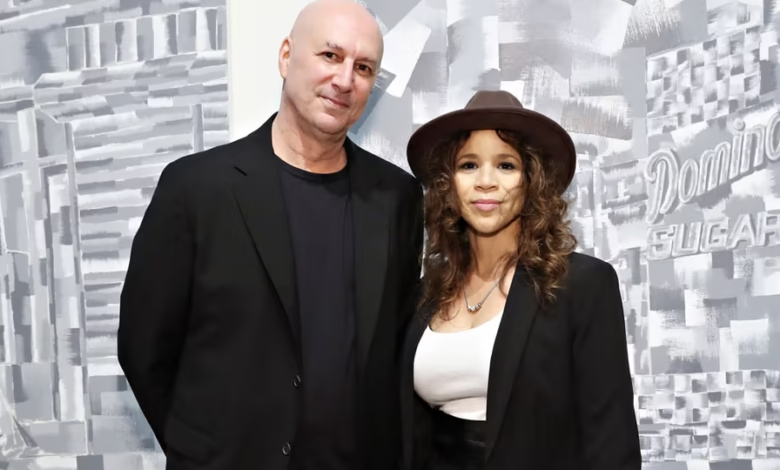
Today, Haze enjoys the fruits of his labor, running his studio out of Brooklyn where he lives with his wife, the Academy Award-nominated actress Rosie Perez—who herself boasts an estimated net worth of around $12 million. While the exact dollar amount attached exclusively to Haze’s personal bank account remains a private matter, focusing solely on the money misses the broader picture. His true net worth is measured in his undeniable influence; he is the man who drafted the visual blueprint for hip-hop and streetwear, leaving a legacy that is, quite frankly, priceless.